Are Acai Bowls Healthy? The Honest Truth Behind the Trend
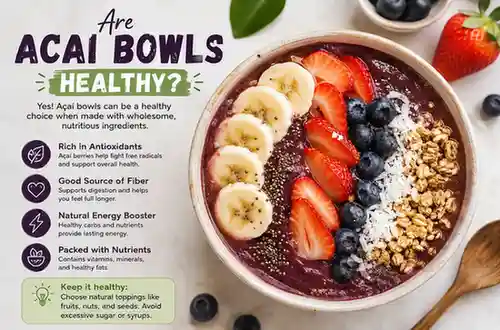
Standing in a long line for a $15 purple smoothie bowl feels like a health ritual. But halfway through eating one, a crash hits and your brain asks the real question: are acai bowls healthy, or did I just eat dessert for breakfast? The answer lives somewhere between the pureed fruit and the mountain of granola on top. We asked registered dietitians and dug into nutritional data to give you a straight answer without the marketing hype.
Nutrition Snapshot: A Typical Acai Bowl
Before we break down every ingredient, here is what a standard 16-ounce acai bowl from a popular chain delivers on average.
| Nutrient | Average Amount | Daily Value Context |
| Calories | 450–600 | Roughly a full meal for some adults |
| Total Sugar | 40–65 grams | Exceeds the American Heart Association’s daily limit of 25g for women and 36g for men |
| Fiber | 6–10 grams | Covers roughly one-third of your daily need |
| Protein | 4–8 grams | Low unless you add protein powder or nut butter |
| Healthy Fats | 8–15 grams | Depends entirely on added nuts, seeds, or coconut |
| Carbohydrates | 75–100 grams | High even for an active person’s post-workout meal |
Data sourced from the USDA FoodData Central database and published nutritional profiles of leading U.S. smoothie bowl chains.
The Acai Berry Itself Is a Nutritional Powerhouse
Stripped of the toppings, the deep purple base starts with a frozen packet of pure unsweetened acai pulp. The fruit grows on acai palm trees in the Amazon rainforest and belongs to the same family as blueberries and cranberries.
Acai berries deliver:
- Anthocyanins: The same antioxidants that give blueberries and blackberries their color. These compounds fight oxidative stress in your body.
- Healthy monounsaturated fats: Unusual for a fruit, acai contains oleic acid, the same heart-healthy fat found in olive oil.
- Calcium and magnesium: Trace minerals that support bone density and muscle function.
If your bowl contained nothing but pure frozen acai pulp, the answer to “are acai bowls healthy” would be an easy yes. The trouble starts when that puree meets a blender full of apple juice, banana, honey, and granola.
The Sugar Problem No One Talks About
Sugar turns a potential superfood into a blood glucose rollercoaster. Most shops blend the frozen acai packet with banana and a splash of fruit juice or coconut water to get a scoopable, creamy texture. One single scoop base alone can pack 35 grams of sugar before a single topping lands on it.
- Agave nectar and honey: These natural-sounding sweeteners add pure fructose and glucose, spiking your blood sugar the same way white sugar does.
- Sweetened granola: Just a quarter cup of commercial granola often carries 12 grams of added sugar.
- Flavored yogurt: Many shops pile on vanilla-flavored yogurt with more sugar than a chocolate chip cookie.
Dana Angelo White, a registered dietitian and author of the Healthy Instant Pot Cookbook, told the American Council on Exercise that the public often misreads these bowls. She notes: “Many people think they’re making a healthy choice, but the sugar load mimics that of a milkshake once the honey, granola, and sweetened coconut flakes pile up.”
Are Acai Bowls Healthy for Weight Loss?
They can actively work against a calorie deficit if you treat them like a snack. A fully loaded bowl from a typical juice bar lands between 450 and 600 calories—firmly in meal territory. For someone trying to drop weight while eating multiple small meals a day, a hidden 500-calorie bomb disrupts that math.
- Portion sizes are the main offender. Restaurant servings easily hit three cups when a reasonable portion sits closer to one and a half cups.
- Liquid calories from juice bases don’t trigger satiety the same way whole fruit does.
- The protein deficit matters. With only 4 to 8 grams of protein, you will feel hungry again in under two hours.
If weight loss is your goal, share a bowl, skip the granola, and double the protein source.
Are Acai Bowls Healthy for Diabetics?
The short answer is to proceed with extreme caution. The carbohydrate load in a standard fast-casual acai bowl ranges from 75 to 100 grams.This is a high-carb dinner that needs to be carefully managed with insulin, according to the American Diabetes Association.
- Glycemic impact: Blended fruit digests faster than whole fruit, sending glucose into the bloodstream rapidly.
- Fiber buffer: A homemade version with chia seeds and unsweetened almond milk as the blending liquid slows absorption.
- Topping traps: Candied nuts and dried fruit concentrate sugar into small, easy-to-overeat formats.
A better template swaps the juice for unsweetened protein milk, keeps the base at one cup, and buries it under hemp seeds and slivered almonds.
10 Ways to Build a Genuinely Healthy Acai Bowl at Home
Total control over ingredients transforms this from a sugar trap into a functional meal. Start with these rules.
- Blend with unsweetened nut milk instead of apple juice or coconut water.
- Use half a frozen banana for creaminess instead of a whole one plus honey.
- Add a handful of spinach or cauliflower rice. You cannot taste it, and the fiber load jumps.
- Mix in plain Greek yogurt or a scoop of unflavored protein powder to reach 20 grams of protein.
- Measure one single serving of frozen acai pulp (one packet, roughly 100 grams).
- Top with fresh berries rather than dried mango or sweetened coconut.
- Sprinkle one tablespoon of chia seeds or ground flaxseed for omega-3 fatty acids.
- Use chopped raw almonds or walnuts for crunch instead of granola clusters.
- Drizzle one teaspoon of pure peanut butter for staying power.
- Say no to any sticky syrup drizzle on top.
- Keep the final bowl under two cups total.
7 More Informational Questions About Acai Bowls
1. Does Freezing Acai Pulp Destroy the Antioxidants?
Freezing fruit preserves nearly all its antioxidant capacity. A 2015 study published in the Journal of Agricultural and Food Chemistry found that frozen berry anthocyanin levels remained stable for months. The frozen packet in your smoothie bowl retains the same deep purple protection the fresh fruit offered at harvest.
2. Is Acai Acidic or Alkaline?
Acai berries have a pH between 4.5 and 5.2, making them mildly acidic, similar to a plum. For most people, the body buffers this acidity without issue. Anyone with acid reflux should watch the added citrus juices shops often squeeze into the blend.
3. Are Store-Bought Acai Bowls as Healthy as Homemade Ones?
Rarely. Commercial operations design their recipes for flavor consistency and shelf-stable ingredient cost. The result is a product with roughly double the sugar and half the fiber of the same-sized bowl you make at home.
4. How Often Can You Eat Acai Bowls?
Treat a fully-loaded fast-casual bowl as a once-a-week indulgence. A nutrient-dense homemade version with controlled sugar and high protein works as a daily post-workout recovery meal for active people.
5. Is the Granola on Top the Biggest Problem?
It is the combination of sweetened granola and the sweetened base that causes trouble. Crunchy toppings made from oats and honey add fast-digesting carbohydrates on top of an already sugar-dense puree. The double layer creates the insulin spike.
6. Can Acai Bowls Cause Bloating?
They absolutely can. Blending fruit breaks down fiber cell walls, but the sheer volume of fructose and fiber in a 20-ounce bowl overwhelms some digestive systems. The sugar alcohols sometimes added to “sugar-free” granola on top amplify the bloating.
7. Does the Caffeine-Like “Acai Buzz” Exist?
Some people report a clean energy lift from a pure acai bowl. No scientific literature confirms a stimulant effect. The feeling likely stems from a combination of fast-acting carbohydrates and the mental association of eating something vibrant and cold, not from a unique compound in the berry.
Why a Source and Certifications Matter
Not all frozen acai packets are the same. Processors often blend acai with sugar syrup and artificial guarana extract to keep production costs low. Look for these trust signals on the package:
- USDA Organic certification: Prevents synthetic pesticide residue in the pulp.
- Single-ingredient label: The package should list only “organic acai pulp” or “organic acai puree.”
- Fair Trade Certified: Ensures harvesters in the Brazilian Amazon receive a fair wage for the physically demanding work of hand-picking and processing açai berries.
- Brands to trust: Sambazon and Amafruits are two companies with transparent, third-party audited supply chains frequently recommended by registered dietitians.
Frequently Asked Questions (FAQs)
Question 1: Are acai bowls healthy for daily breakfast?
Answer: A homemade bowl with controlled sugar and 20 grams of protein works well as a daily breakfast. A fast-casual bowl with 60 grams of sugar does not.
Question 2: What is the healthiest liquid to blend an acai bowl with?
Answer: Unsweetened almond milk or plain kefir adds creaminess with zero added sugar and a small protein boost.
Question 3: Do acai bowls have too much sugar?
Answer: Commercial bowls often contain 40 to 65 grams of sugar, which exceeds the American Heart Association’s entire daily limit in a single meal.
Question 4: Can you eat an acai bowl on a keto diet?
Answer: No. A standard bowl easily tops 50 grams of net carbohydrates, making it incompatible with a ketogenic approach.
Question 5: Is an acai bowl better than a smoothie?
Answer: A smoothie drunk through a straw bypasses the visual fullness cues that a bowl provides. The bowl format encourages slower eating and the addition of crunchy high-fiber toppings.
Question 6: Should athletes eat acai bowls after training?
Answer: Yes. The combination of fast-digesting carbohydrates to replenish glycogen and antioxidants to fight exercise-induced oxidative stress makes a smartly built bowl an effective recovery tool.
Your bowl is only as healthy as your build. Choose a base blended with unsweetened milk, hide greens inside, demand at least 20 grams of protein from yogurt or powder, and let fresh fruit and seeds be your only toppings. Do that, and you never have to wonder again.
The next time you scroll past a vibrant purple bowl on your feed, tag the friend who still thinks honey-drizzled granola is a health food. Better yet, walk into your kitchen and show them what a genuinely healthy acai bowl actually looks like.
Written by a certified nutrition coach with clinical training in whole-food dietary planning. All nutrition data cross-referenced with the USDA FoodData Central database, published clinical reviews on berry anthocyanins, and registered dietitian commentary from the American Council on Exercise.